


Look up at the sky; there’s something incredible going on — some half a billion miles from Earth.
In early July, the NASA space probe Juno entered into orbit around Jupiter – the largest planet in our solar system — and Guinness World Records promptly named the $1.1 billion probe the fastest-ever spacecraft in history.
Helping to reach that historic milestone, which began in August 2011 when Juno left Cape Canaveral Air Force Station, is the Melbourne, Florida-based satellite and communications giant Harris Corporation.
Over the past year, more than 100 Harris employees have provided critical operations, maintenance and engineering services to make the Jupiter Orbit Insertion, as it’s called, a reality.
That support has centered on work at the Jet Propulsion Laboratory, the federally funded research and development center responsible for operating NASA’s Deep Space Network — the worldwide network of antennas and communications facilities in the United States, Spain and Australia.
Decades-Long Collaboration
Harris’ work in deep space speaks to an ongoing collaboration stretching back generations.
“We’ve been supporting NASA for decades,” says Carl D’Alessandro, president of the Critical Networks segment, speaking recently from Harris’ corporate headquarters in Florida.
“In fact,” D’Alessandro adds, “the core of the company was started in Florida to support NASA and space flight — it’s a legacy of more than 55 years in support of traditionally unmanned and later manned space flight.”
That long partnership continues with Juno.
Imagine communicating with a spacecraft billions of miles from Earth – and the supporting ground infrastructure needed to make it happen. That’s the work of Critical Networks, one of four operating segments within Harris.
Dazzling First Image
Recent news stories have shown a dazzling first image taken by Juno — relayed to NASA’s Deep Space Network – that captures three large moons orbiting Jupiter.
The task of running NASA’s Deep Space Network, which consists of three large antennae complexes worldwide pointing to spacecraft in deep space, falls in part to Harris Corporation.
In all, Harris operates and maintains seven large antennas for the DSN, along with multiple network and communications systems, network operations centers, and facilities for testing, logistics, and maintenance and repair.
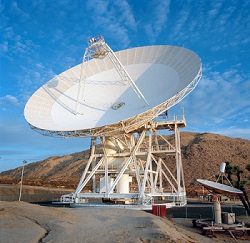
“We are responsible for this huge physical infrastructure, like a 70-meter antenna that’s 50 years old, and for operating and maintaining all of the infrastructure at the facility to make sure it’s up – that includes power, HVAC and electronic equipment,” D’Alessandro says.
That massive infrastructure helps fuel communication with Juno — in 96 minutes, round-trip. And that work doesn’t come easily.
Communicating with Juno
The incoming signal strength during the Jupiter Orbit Insertion, traveling at the speed of light, is so weak it requires five antennas worldwide to receive it.
“The signal that actually hits the ground is a billionth of the signal strength that a cell phone gets,” D’Alessandro says.
“If you think about the numbers and challenges associated with establishing this link, it’s remarkable,” adds D’Alessandro, who started with Harris in 1984 out of college as an integration and test engineer, and retains his enthusiasm for the company mission all these years later.
Equally remarkable, D’Alessandro says, is the reality that successful communication requires four-thousandths of a degree in pointing accuracy of the DSN’s antennas.
“It’s like hitting a hole-in-one from the East to the West Coast,” D’Alessandro says.
More Deep Space Missions
A good many “rehearsals,” as D’Alessandro puts it, underpin mission success. Preparing antenna receivers is just one of many examples of such rehearsals.
“We have to cool them to 5 degrees above absolute zero — we are talking about -450 degrees Fahrenheit,” D’Alessandro says, noting that step is mandatory just to receive a signal.
In addition to Juno, Harris supports other deep-space missions — Voyager 1 and 2, the Mars Exploration Rover Project, Curiosity and the Cassini Saturn mission.
Then, there’s the company’s work providing NASA with near-Earth spacecraft connectivity through the Space Communications Network Service. Harris provides the same kind of support to SCNS as it is does for DSN.
Reaching Farther Into Space
Looking ahead, it isn’t just unmanned spacecraft D’Alessandro envisions Harris leaving its mark.
“Hopefully, in the future, we will return to supporting manned missions,” he says, echoing a long-held wish within NASA circles.
In the meantime, D’Alessandro is focusing on more immediate breakthroughs — as in the field of laser communications.
“One thing we’ve been involved with for a long time is using lasers to communicate — that allows you to [have]very, very high bandwidth and transfer huge amounts of data,” D’Alessandro says.
“We’ve been doing research on it for quite a few years,” he adds, “and it’s exciting to think about how it can be applied to deep space communications.”
More Jupiter Images Ahead
Harris’ innovation in deep space is unfolding as we speak.
On the heels of Juno’s successful July 4 orbit insertion, there’s more to come from the spacecraft before it concludes its mission in February 2018.
As the spacecraft orbits Jupiter a total of 20 months, for 37 orbits, another dazzling image is already in the works.
On Saturday, Aug. 27, Juno is expected to take the first high-resolution image of Jupiter, after making its next close pass of the planet.
“Harris and the DSN prepared for Juno’s rendezvous with Jupiter for well over a year to ensure the success of this mission,” D’Alessandro says.
“So, the team is ready and excited to play its part in yet another NASA first on Aug. 27,” D’Alessandro adds, “by successfully bringing the high-res images from Juno to Earth, some 500 million miles away, as only the DSN can do.”