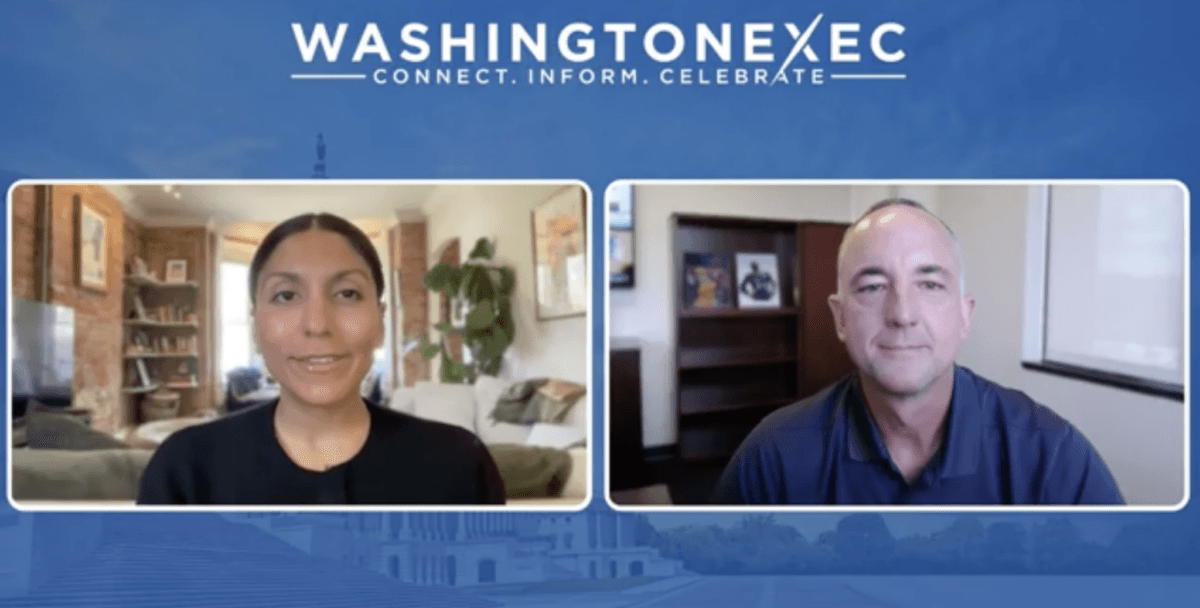
Paul D. Mehney comes from an Army civilian family spanning two generations, so in the wake of 9/11, a career in defense became an easy choice. Already backed by mission, his call to serve evolved into a two-decade journey, shaping how Army acquisition offices tell complex modernization stories and forming the foundation for his career to follow.
Today, Mehney is vice president of strategy and communications at Thales Defense & Security, Inc., where he brings that same mission-driven mindset to industry. He bridges the gap between capability and comprehension and ensures the technologies supporting the warfighter are understood.
In this Q&A, he reflects on the power of storytelling in national security, the urgency driving today’s defense landscape, and why collaboration across government and industry has never mattered more.
Can you provide a brief overview of your professional background and career progression?
I began my defense-related career with federal government service in the Department of the Army after the 9/11 terrorist attacks that so rattled our nation and world. For the next two decades, I served in various public and strategic communications roles within Army acquisition offices. We built strong communications teams that fostered better stakeholder understanding of key Army programs such as combat and tactical vehicle modernization efforts, Future Combat Systems, and eventually Army tactical network transformation.
Each career step provided not only professional growth and opportunity, but also fostered learning experiences in coordinating and managing media affairs, legislative actions and eventually industry affairs—leading to a better understanding of government/defense industrial base relations and issues. This combination of skill sets lead to a transition path from government service to defense industry where I am now part of a great innovative strategic communications team at Thales Defense & Security in Clarksburg, Md.
Why was this the path you chose, and how influential was it to your career?
The path after 9/11 was an easy choice for me, coming from an Army civilian family going back two generations. The challenge was where I could contribute the best with my liberal arts degree and background as a magazine editor and writer. Interestingly, the Army became a perfect fit as there was a strong need to shape and tell material modernization and readiness stories surrounding the Global War on Terror.
These early years supporting Army acquisition shaped my career path and still form the foundation of what our Thales team executes, which foundationally is shaping capability narratives and working across business lines (very similar to Army product management offices) to develop strategy and marketing plans for advanced capability to support warfighter operations.
Do you have a personal connection to the current mission you support?
As with many in the defense industry, a deep personal connection exists with our mission to rapidly provide innovative technology to our nation’s Armed Forces. Relationships formed while in government service bleed into industry both in terms of understanding how the end customer operates capability, but also in collaborative development efforts—ultimately leading to innovative and faster capability transfer to the operational community. A sense of urgency exists within the defense industry like no other! Working alongside prior service members and government civilians has enabled the team to maintain deep personal connections across our customer base.
What are your current top priorities and responsibilities? How do these relate to your company’s overall mission/growth strategy?
Our marketing and strategic communications team continues to work across business lines to facilitate the ability to win core business and rapidly innovate and manufacture capability for the Department of War and Homeland Security customer base. Top priorities include blending brand awareness, marketing, media and government relations strategies to formulate and execute outreach plans to result in increased awareness for key business pursuit areas.
Navy Remote Mine Hunting, Army Next Generation Command and Control and modular signal intelligence kits are just a few important initiatives. A key to these activities is a strong collaborative relationship between marketing, proposal management and business development teams across the company. Open communication is extremely important to drive plans to fruition.
Where do you and your team see growth opportunities in your current field or portfolio you support, or what do you anticipate to be your customers’ top pain points?
Navigating ever-evolving military requirements and moving at the pace the department is demanding while also lacking strong, predictable order forecasts remains a challenge across several of our business lines. But opportunities abound, and over the past year, TDSI has adapted business practices to move much more rapidly in terms of capability development, integration and production capacity.
Our marketing and communication team has remained flexible to support emerging opportunities linked to customer focus areas such as Navy distributed anti-submarine warfare, advancement of helmet-mounted display technology for fixed and rotary wing pilots, integration of new secure waveforms for Special Operations and Army radios, integration of networked biometrics for the tactical edge, and delivery of multi-band multi-orbit satellite terminal technology.
How are you and your team planning to address/prepare for these opportunities?
Working across business lines while having a firm understanding of government customer needs and acquisition strategy helps shape marketing and outreach efforts and build growth beyond our core business. In any company, marketing and communications must be a transparent part of the business growth decision process, not only advising product-to-market strategy but also as part of the strategic market research processes in order to advise corporate leadership on probability of win.
One of TDSI’s greatest strengths is the diversity of our portfolio. We are not dependent on a single product, market, or customer priority. We operate across communications, electronic warfare, cyber, avionics, SATCOM, sonar, undersea systems, sensors, biometrics, and advanced mission technologies. This breadth gives the company the ability to absorb shifts in one market while accelerating growth in another. It also provides a great deal of opportunity to develop and execute a diversity of marketing plans to support some of the most urgent needs across the U.S. defense industrial base, including resilient communications, spectrum dominance, maritime security, tactical mobility, trusted cyber, and advanced sensing.
Another important aspect is political engagement. Political activities can result in tremendous engagement with elected officials and key stakeholders, which is extremely important to business and to the broader defense industrial base. These engagements help ensure policymakers understand our capabilities, our workforce, our manufacturing footprint, and the role we play in supporting U.S. national security.
How important is mentorship & networking in GovCon? Were they influential to your career?
Continuous government/industry transparent collaboration and mentorship are extremely important in today’s rapid pace of delivery environment. Collaboration across user, requirements and procurement organizations is key for industry to understand needs and program timelines and for the government to understand potential opportunity or constraints within industry, such as supply chain health and production capacity. Continual education and learning hand-in-hand with the customer are key to any successful career and personal development.
What is something most people don’t know about you personally?
Believe it or not, I am an actual history major (all jokes aside). I started to collect American Civil War antiques when I was 12 years old—much to my parents’ dismay—as they were then forced to take me to EVERY Civil War battlefield while growing up. I still collect Civil War military antiques and antique photography. A deep understanding of history has helped shape my career perspectives, as well as fostering an intimate respect for our military and its history.