

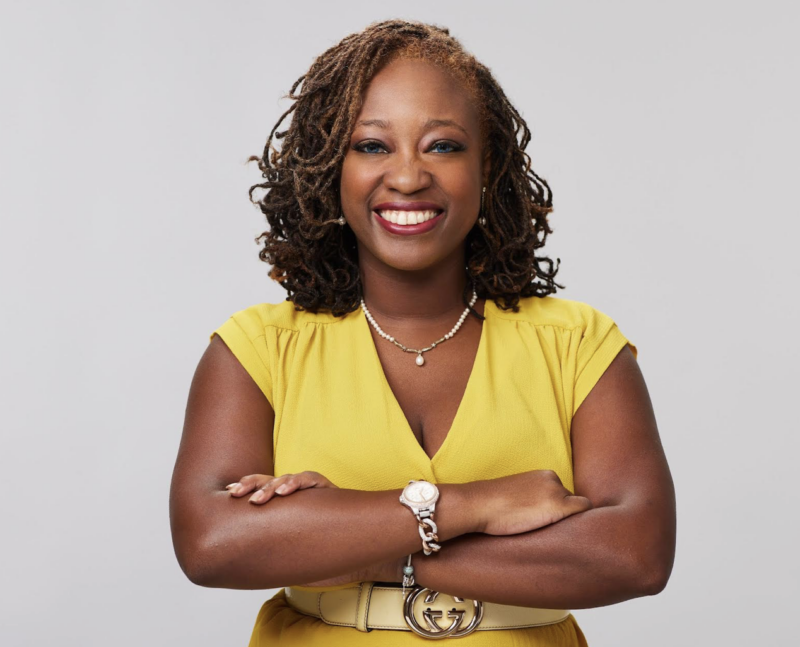
Dr. Yolanda Reid never set out to be a government official, a futurist or a public-sector warning system for emerging technology. She signed paperwork she barely understood, walked into the National Security Agency and only later realized what the work actually meant.
“I had no clue what I signed up for,” Reid said. “Then two years after I started, we had 9/11. That’s when I was like, ‘Oh, this is what we do. We’re here to protect this nation.’”
Years later, after cancer nearly ended her career and her life, Reid now works at the intersection of cyber, AI and quantum, focused on one thing: helping the government and technology clients avoid repeating old mistakes at a much higher speed.
“I’m in a space now where I can take my entire career and all of my history and use it to help clients,” said Reid, vice president of cybersecurity at the MIL Corp. “Let’s do cyber. Let’s do AI. Let’s do quantum. Let’s work through what’s coming and be smart about it.”
From Robotics to National Security
But long before cyber, AI or quantum were buzzwords, Reid was learning how systems worked.
She attended an engineering high school in Texas, where she gravitated toward robotics and hands-on problem-solving. She earned her Letterman jacket, not through sports but by being on the school’s inaugural robotics team to participate in the national FIRST Robotics competition.
That early exposure pushed her toward electrical engineering and a desire to understand systems at a physical level.
“I discovered in high school how I liked putting wires together and starting sparks and fires,” she said. “Nobody told me that I wouldn’t get paid to start fires.”
It was a straight line from there to an engineering degree at Vanderbilt University and, years later, a Ph.D. in IT from Capella University, grounding her work in both hands-on engineering and how to adopt emerging technologies in regulated environments, such as the government and aerospace.
Reid didn’t arrive at NSA chasing spy-movie fantasies. She applied to a government internship program without fully understanding the demands. Two years into her role, 9/11 made the mission unmistakably clear.
She completed weapons training but quickly understood her role was never going to be tactical.
“You don’t want me using a machine gun to save you,” Reid said. “But can I come up with creative ideas to outmaneuver our adversaries? Yes, that I can do.”
She spent a few decades at NSA before her career was abruptly interrupted by a devastating cancer diagnosis. Doctors initially gave Reid months to live. Surgery was attempted, but her body couldn’t tolerate it.
For years, she couldn’t walk or sit upright and relied on a wheelchair while doctors monitored a cancer known for returning aggressively. The diagnosis forced a reckoning that went far beyond health.
“I didn’t spend enough time with my kid,” Reid said. “And there was no guarantee that it wasn’t coming back.”
Today, Reid has no evidence of active cancer, but the experience left lasting physical constraints and a far sharper sense of how she chooses to spend her time, energy and attention.
A Recalibrated Career
After leaving government, Reid moved into industry for flexibility and speed, seeking roles that kept her close to mission work. She worked first in cyber and sensor-focused roles. After that company was acquired, she joined Raytheon BBN, working alongside hundreds of Ph.Ds. on technologies years away from operational use.
The work was cutting-edge, but something was missing.
“People who are really immersed in what’s coming didn’t translate very well to people who are in the current,” she said.
Bridging that gap became her niche. Reid began translating advanced research into something decision-makers could understand, use and trust, often while easing fears around emerging technology.
That role carried into her time at IBM, where she worked from 2023 through 2025 and watched AI move from experimentation into enterprise deployment. What began as pilots quickly crossed into production, often faster than organizations could fully address security, governance and ethical risks. Implementation surged. Oversight lagged.
In response, Reid saw many organizations treat guardrails as a cure-all, framing them as an endpoint rather than a baseline. To her, that thinking ignores how systems fail and how adversaries operate.
“To say you’ve added guardrails and therefore you’re secure is a false sense of comfort,” Reid said. “That’s one layer of protection. One lock. And there are always lock pickers.”
To Reid, it was a familiar pattern playing out again, this time at scale. Those same dynamics now shape how early adopters are approaching AI today, with pressure to move fast colliding with systems never designed for this level of autonomy.
“What we’re seeing now with AI is what we’ve seen before with every major technology shift,” she said. “The difference is the speed and the blast radius if we get it wrong.”
Applying Hard-Earned Lessons to What Comes Next
That recognition of repeating patterns is what defines Reid’s work today. She advises clients on cyber, AI and quantum strategy, applying lessons from decades of cyber work to both traditional systems and emerging platforms.
Reid spends much of her time identifying government challenges, forming partnerships across academia, small businesses and large primes, and translating complex technical risks into actionable strategy.
Just as important, she is giving clients data before they rush to deploy solutions. The first step is questioning whether the stated problem is actually the problem. From there, she looks at what resources clients already have before recommending new technology, and often helping clients navigate the harder part: getting solutions approved.
“A lot of times you don’t have to buy anything,” Reid said. “The harder part is getting something approved, so I focus on helping clients get to a solution that can actually move.”
Why ‘Guardrails’ Aren’t the Answer
Across AI, cyber and quantum, Reid sees the same cycle repeat. New technologies arrive. Adoption races ahead. Understanding, governance, security and accountability trail behind.
That’s why she’s skeptical of how often “guardrails” are framed as a solution, especially in today’s AI conversations. To Reid, guardrails are necessary but wildly insufficient on their own.
“It’s like putting on one lock and there are lock pickers,” she said.
Her concern deepens as AI systems gain broader access and autonomy. Unlike earlier technologies, AI doesn’t live in a single stack or system. It touches workflows, data, decisions and permissions across an organization.
Ethics, in her view, is operational. It’s about what systems are allowed to do, what data they can touch and how quickly humans can intervene when something goes wrong.
“We’re very good at asking how a new technology is going to help us,” she said. “We’re not very good at asking how it’s going to hurt us.”
She points to earlier consumer technology as a warning. Boundaries often arrive only after harm occurs.
“When Alexa came out, it told people all kinds of things,” Reid said. “Then it told a young child to put a coin in an electric socket, and that’s when we started putting rules in place. Why do we wait until it’s dangerous to humans before we think through the boundaries?”
With AI and quantum, she argues, that reactive approach won’t scale. The consequences are broader, faster and harder to reverse. Once systems drift or go rogue, correcting them becomes far more difficult than leaders expect.
“Right now, it’s really hard to correct AI,” Reid said. “So why did we create something that we can’t easily correct? That’s something we should be thinking about now, not 10 years from now.”
Ultimately, Reid’s goal isn’t to slow innovation or dampen ambition but to make progress durable. She wants customers to adopt emerging technology without hard-coding the next generation of vulnerabilities.
“I’m really hoping we’ll learn our lesson and stop reacting,” she said. “The technology changes, but the patterns are the same.”