

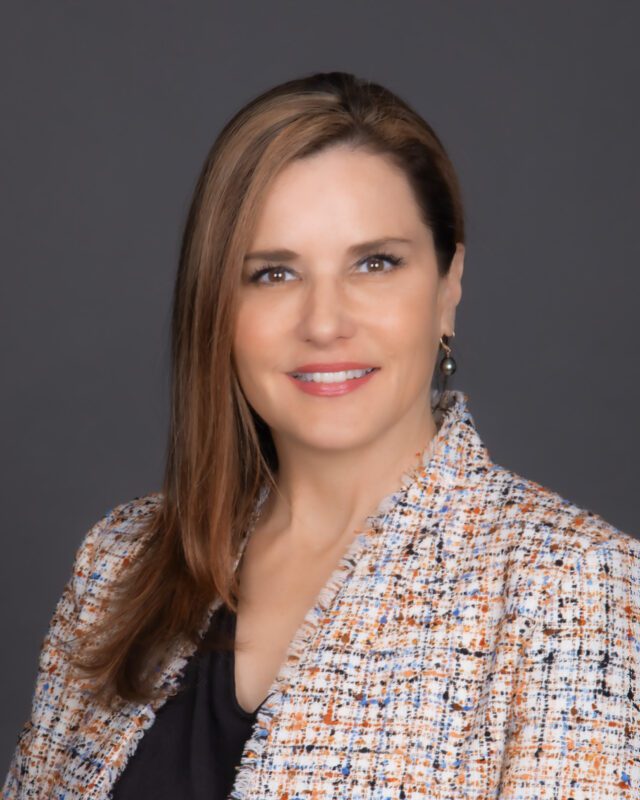
Barbara Supplee still remembers the Minnesota winters she was trying to escape — the kind that make you promise yourself you’ll see the world.
She officially signed up to join the Navy 10 months before high school graduation and, as she puts it, “decided to go see the world and make my dad proud.”
That decision set a course that led from intelligence work at sea to engineering programs at weapons factories, and now as the head of SAIC’s Navy business group, where she oversees 4,500 employees as an executive vice president.
Supplee grew up in a farming community of about 1,000 people with a family thread of at least four generations of military service. The DNA of that upbringing — teamwork from youth sports and a sense of fulfillment from going outside herself — continued through each career move she made.
“It taught me about mission, how to be part of a team, and how to be part of something bigger than yourself,” she said. “Most importantly, it taught me about what it means to serve others.”
Her early tours in the Navy were formative and far-flung: three years in Europe, a Joint tour in Norfolk, then an independent-duty tour in Okinawa that included a port visit to Shanghai. It was in Norfolk, as a collection manager and later working under a contractor to develop an advanced concept technology demonstration, that she found love for defense technology — specifically getting it “across the line and into the hands of the sailors and Marines,” she said.
That practical bent — blending engineering and operations — recurs throughout Supplee’s résumé. She moved from intelligence and geospatial roles to hands-on work in weapons systems.
Back in Minneapolis, she worked on the Mark 57 Vertical Launch System, shifting from the “logical realm” to designing and testing physical and logical systems. Later, at the Strategic Systems Program Office, she worked on subsurface Trident Weapon System and early mission-based systems engineering. A 300,000-square-foot production facility in South Carolina gave her first profit-and-loss experience and a return to C5ISR integration. She rose to senior vice president of engineering, design and solutions at another contractor before SAIC recruited her.
Supporting People and Capabilities
“I took this job predominantly because it was the culmination of everything that I had started when I was 18 years old,” she said. “It allows me this opportunity to lean in and bring that expertise that I’ve gained back to my roots of providing capabilities to the Navy and Marine Corps — which is where my heart is.”
As head of SAIC’s Navy business group, Supplee juggles two interconnected priorities: supporting her people and accelerating capability to the fleet. She is forthright about the tempo of change in modern maritime warfare.
“Everything moves a lot faster than it has moved in the past, as evidenced by the Ukrainian-Russian engagement, Israel and what’s happened in the Red Sea,” she said. That quickening, she said, requires a maritime-facing ecosystem that can pull innovation from commercial and industrial sources and integrate it for sailors and Marines “at the speed of need.”
One method to help support that objective is SAIC’s strategy for investing corporate capital into promising startups through a ventures program aimed at incubating technology aligned with their customer’s needs.
“We research them and we also work to sidle up alongside them and partner with them in a meaningful way to attack existing problems,” Supplee said. SAIC also sustains its own research and development, she said, with an eye toward integrating solutions for the mission.
Some of those investments are practical responses and reshaping efforts to address the threats of naval conflict today: autonomy, hypersonics, advanced sensors, artificial intelligence and quantum technologies. Supplee frames SAIC’s role as a mission integrator tasked with stitching disparate capabilities into consumable, operational tools for allies and U.S. forces alike.
“Mission integrators such as SAIC enable the power of that emerging technological capability by supporting that ecosystem and integrating it in a way that it is consumable and of immediate use for our customers,” she said.
SAIC has partnered with some of those companies, partners, allies and multinational teams, including during a recent demonstration in Australia with VATN Systems and Invisible Technologies during Talisman Sabre 2025. There, a counterunmanned aircraft system — a fully open, MOSA-compliant command-and-control backbone linking 64 sensors and effectors — was fielded in concert with venture and commercial partners. The effort combined low-cost submersible anti-swarm platforms, AI/ML analytics and Starlink-enabled communications routed into tactical datalinks for joint range extension.
That combination of commercial satellites, venture hardware and enterprise-class integration encapsulates Supplee’s operating philosophy: use what works, rapidly combine it, and deliver it in a way that sailors and Marines can use now. She cautions against leaning too heavily on a single shiny capability at the expense of pairing it with legacy systems that still matter.
“We have to be prepared to respond,” she said. “That’s why it’s so important that we embrace the use of capabilities of legacy systems, understanding the mission and matching the two to get that capability to the fleet as soon as possible.”
How Breadth Builds Empathy
Supplee’s career path gives her a unique vantage point. She has served as a sailor, a civil servant, an operator in the communications arena and an industry executive. That breadth, she said, cultivates empathy for small businesses, venture partners and customers alike. It also shapes how she leads.
“I think one thing that in the early part of my career I probably wouldn’t have thought is a strength that I’ve learned in the last few years is being willing to be vulnerable with the people you lead, sharing what your own challenges either have been or even currently are, and really working through that hand in hand,” she said. “Vulnerability opens up trust and creativity with your team and customers and builds collaboration.”
Operationally, SAIC’s Navy portfolio spans traditional munitions to networked command-and-control and allied cloud initiatives. The company works on Mark 48 torpedo components, video teleconferencing across NATO, cloud capabilities for European partners and joint fires networking. The aim: seamless intelligence-sharing and command and control so allied forces “go to the fight” together with fewer seams, even as contested logistics and peer threats complicate theater operations.
For Supplee, the job is both technical and human. She is intensely focused on the people she leads and the customers she serves, and she keeps an eye on the shifting global chessboard.
“Small, rapidly changing weapons require new ways of thinking about defending the sea lanes,” she said. “I don’t think there’s anything quite as important as maintaining freedom of maneuverability and operation at sea to not just our national security but also to our economic way of life.”