

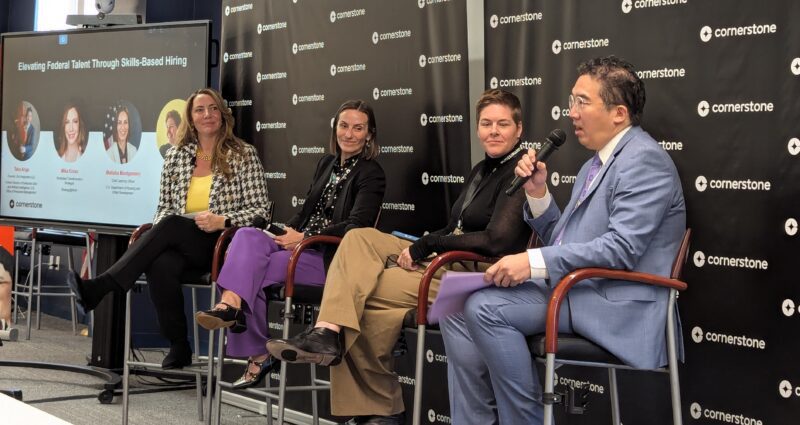
Federal hiring has long tested even the most patient applicants. Ten months at the Government Accountability Office to get a job, nine months at the Office of Personnel Management.
“You can’t ask someone to put their life on hold waiting for an uncertain decision for 10 months,” said Taka Ariga, a former GAO and OPM official and a panelist at the Oct. 23 Federal Innovation Summit.
Now, artificial intelligence is beginning to change that.
Organized by Cornerstone, a learning technology company, the event brought together government and industry leaders to discuss how AI can modernize hiring, not by replacing people but by cutting friction from a system that often shuts qualified candidates out.
“It’s a double-edged sword,” said Ariga, former chief AI officer and chief data officer at OPM. “Not only can we use AI to accelerate and improve the process, but because of the prevalence of deepfake and misinformation, it also presents challenges for us to source through, especially with the volume of resumes that we get.”
He pointed to the 2210 job series, a catchall category for federal tech roles that includes everything from database administrators to AI engineers.
“That job series is so wide you can drive three school buses side by side and ram right through,” he said. “You use 2210 to hire a database administrator. You use 2210 to hire data engineers, and they’re categorically different skill sets. But if you read 10 position descriptions under 2210, you get 10 different ones. There’s no consistency.”
That’s where AI could help, he said. It can standardize job descriptions, match skills to roles and help applicants see how their background fits without decoding federal jargon. It can format federal resumes, flag plagiarism or fake experience, and guide career paths so technical experts — like AI engineers or database administrators — aren’t lumped into one generic “IT” track.
But technology can only do so much. In the federal space, moving into a new career often means starting over, even for seasoned employees already performing at higher grade levels, said Matisha Montgomery, chief learning officer at the Department of Housing and Urban Development.
“If I wanted tomorrow to become a data scientist or an AI engineer, I’m not going to qualify at the highest grade levels; I’m going to qualify at the entry level if I get the training,” she said.
She said the government must figure out how to help people “reinvent themselves” and move into the roles agencies need most.
Workplace expert and moderator Mika Cross said the future of federal hiring is about growing talent from within, not just bringing in new people. She shared an example from MasterCard, where an internal campaign encouraged horizontal, skills-based mobility by reminding employees their “dream job might be down the hallway.” Cross noted this kind of messaging, paired with intentional talent development strategies, can be transformative in federal environments where rigid structures often limit career mobility.
“I think really messaging that to a workforce that needs to understand that it is time to level up and that there might be opportunities not necessarily in a different grade or a different position, but rather in the same organization just doing different work — is really powerful,” Cross said.
That cultural shift might be the hardest part.
“We all have some thoughts on AI,” said Stacey Swinehart Ganderson, head of accessibility at Cornerstone. “For the job description, they might have, ‘We want you to be fluent in AI,’ whatever they mean by that — they probably don’t know when they wrote the description. And yet they still don’t really know what that really means to being effective in our roles.”
She called out a paradox: Agencies want candidates fluent in AI but often ban its use during hiring.
“It is considered a cheat,” she said. “It is a weird double standard paradox that’s going on here that I’m like, it’s fascinating — and I hate it.”
Swinehart Ganderson also reminded the audience that AI isn’t a substitute for human thinking.
“Someone built this thing, and the algorithm may or may not be great,” she said. “If I don’t put the correct prompt in or ask it the right things in the right way, I’m going to get crap output.”
In the end, Ariga said AI’s promise isn’t to replace people but to ease the process.
“We can use AI to streamline the hiring process but not use it to replace workers,” he said. “We can actually, as a public sector, set an example of what good might look like.”
Ariga said the next challenge is breaking down silos across agencies so innovations in one can benefit all.
“HUD hires people. IRS hires people. The SSA hires people,” he said. “Why should every single agency have their own bespoke use of data and analytics and skill-based hiring? If OPM was able to develop a series of use cases, why can’t we make it available to all of the federal agencies?”