

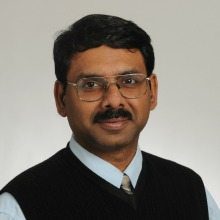
Padmanabhan Seshaiyer is the Director of COMPLETE (Center for Outreach in Mathematics Professional Learning and Educational Technology), A Joint Center between the College of Science and the College of Education and Human Development at George Mason University (GMU). He is also an Affiliate Faculty Member of both GMU’s Mathematics Education Center, Graduate School of Education and The School of Mathematical, Computational, Communication Science and Engineering (MCCSE) at the Nelson Mandela African Institute of Science and Technology in Arusha, Tanzania.
We caught up with Seshaiyer this summer and he talked about how he became involved in GMU’s STEM Accelerator program, why STEM is critical to the success to the future of kids today, what he most likes about his work on STEM and more.
WashingtonExec: Tell us about your current role with STEM, what exactly are you doing?
Padmanabhan Seshaiyer: I currently serve as the Director of the STEM Accelerator program in College of Science at George Mason University (GMU). In this capacity, I work with a dedicated group of faculty on developing and implementing initiatives to help prepare the next generation STEM workforce. Specific goals include increasing the number of STEM majors, improving retention rates in STEM, reducing time to graduation and helping students join the STEM workforce. I also direct a center that has helped provide professional development to over 700 K-12 teachers from 10 school districts in the past five years. (More information about the program can be found here).
__________________________________________________________________________________________________
“STEM engages and enhances student learning through a variety of approaches including field-experiential, collaborative, hands-on, experimental, research driven as well as virtual learning environments which help the students connect the content they learn in the classroom to the real-world”
___________________________________________________________________________________________________
WashingtonExec: Why is STEM critical to the success to the future of kids today?
Padmanabhan Seshaiyer: STEM or Science, Technology, Engineering and Mathematics is truly an interdisciplinary area that has the potential to excite and engage kids at all levels. The connections between multiple disciplines not only helps the kids today to become better scientists and innovators but also better collaborators, communicators, critical thinkers and creative problem solvers. STEM exposes kids to a scientific approach to problem solving that is inquiry-based. It also helps them to think like engineers to apply design thinking in the solution process. STEM engages and enhances student learning through a variety of approaches including field-experiential, collaborative, hands-on, experimental, research driven as well as virtual learning environments which help the students connect the content they learn in the classroom to the real-world.
WashingtonExec: Does GMU have a long-term plan on STEM? What comes next?
Padmanabhan Seshaiyer: GMU recognizes the great need to invest in STEM education for a variety of reasons including, the demand for professionals in the STEM field that is expected to overtake the supply of trained workforce, the need to train the workforce on STEM competencies and skills required, the need to improve the K-12 educational system in order for us to move from “middle of the pack” in reading, mathematics and science to the top, and the need for more participation from women and minorities who are greatly underrepresented in the STEM fields.
GMU hopes to create new initiatives and programs that can help to build a strong foundation right from elementary school and make sure that there are critical STEM transition programs as the students move from elementary, all the way to graduate school. These could be as simple as STEM after-school clubs in schools for K-12 students, working with K-12 teachers to enhance their pedagogical skills to incorporate STEM activities into their curriculum during class time, exposing K-12 students to STEM careers, engaging undergraduate students in research and internship opportunities with local business partners, and advancing multidisciplinary research collaborations among undergraduate and graduate students, faculty through STEM partnerships.
WashingtonExec: What do you like most about your work on STEM?
Padmanabhan Seshaiyer: Our current educational system preaches, “Here is the STEM content; go solve the problem.” Think about how powerful and effective learning would be if we as educators change this philosophy to: “Here is the problem. Let us find the STEM content to solve it!” This is what I practice and this is what I preach! I enjoy helping students make those important real-world STEM connections.
WashingtonExec: You have mentored several high school students. Tell us more about that.
Padmanabhan Seshaiyer: I have had several high school teachers come to me for advice on how to respond to the most popular question from students which is, “When do I ever use this in real-life?” So over the years, I have developed several programs for high school students to get them exposed to the same type of research that undergraduates and graduate students work on. As I started exposing them to simpler applications, it became evident to me the need to teach them about modeling, analysis and implementation of real-world phenomena using simple ideas from the high school curriculum. Over the last few years, I have been able to work with about 15 high school students to guide them on multidisciplinary research. These students have received prestigious recognitions for their projects from Intel Science and Engineering Fair to the Siemens Foundation along with winning grand prize awards in the regional competitions. I am most proud of having published with some of these high school students in peer-reviewed journals.
WashingtonExec: What, if any experiences have influenced your thought processes? Positive or negative?
Padmanabhan Seshaiyer: While STEM sounds very easy to talk about, being able to bring diverse STEM fields together to work on a common problem is not easy. For example, a neurosurgeon who works with aneurysms may decide when to do invasive surgery based on his/her experience. However, collaborating with a scientist may make it possible to develop computer models of real-time patient data that can help the neurosurgeon make better clinical decisions on the need for surgery. But this collaboration between a scientist and a neurosurgeon requires more than just partnership; it requires them to build respect on each other’s expertise to collectively make informed decisions. While such STEM collaborations are natural for some of us, it is not the same for everyone. We are far from convincing experts that work on their separate areas to be able to talk to each other in a common STEM language and collaborate to develop multidisciplinary STEM partnerships.
